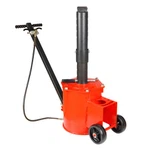
Comparing a bottle jack to a scissor jack involves evaluating their respective strengths, weaknesses, and suitability for different lifting applications. While both types of jacks serve the common purpose of lifting vehicles and other heavy loads, they have distinct differences in terms of design, functionality, lifting capacity, stability, portability, and application suitability. Let's delve into the comparison to determine whether a bottle jack is better than a scissor jack or vice versa:
1. Design and Construction:
Bottle Jack:
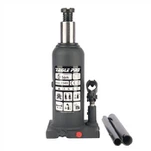
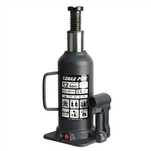
Bottle jacks feature a vertical hydraulic piston housed in a cylindrical body, resembling a bottle, which extends to lift the load.
They rely on hydraulic pressure to lift objects vertically, with a pumping mechanism operated by a lever or handle.
The compact design of bottle jacks makes them suitable for use in confined spaces or low-clearance environments.
Scissor Jack:
Scissor jacks consist of a collapsible X-shaped mechanism, resembling a scissor, which extends vertically to lift the load.
They operate by mechanical means, typically using a crank handle to turn a screw mechanism that extends or retracts the scissor arms.
Scissor jacks are generally more compact and lightweight than bottle jacks, making them easier to store and transport.
2. Lifting Capacity:
Bottle Jack:
Bottle jacks are available in a wide range of lifting capacities, typically ranging from 2 tons to 50 tons or more.
They are capable of lifting heavier loads compared to scissor jacks, making them suitable for lifting vehicles, machinery, and heavy equipment in industrial and automotive applications.
Scissor Jack:
Scissor jacks have a lower lifting capacity compared to bottle jacks, typically ranging from 1 ton to 3 tons for consumer-grade models.
They are primarily designed for lifting vehicles, such as cars, SUVs, and light trucks, during roadside emergencies or maintenance tasks.
3. Lifting Height:
Bottle Jack:
Bottle jacks offer a relatively high lifting height compared to scissor jacks due to their vertical design.
The maximum extension height of a bottle jack is determined by the length of the hydraulic piston and the size of the cylinder.
Scissor Jack:
Scissor jacks provide a limited lifting height due to their compact design and mechanical operation.
The maximum extension height of a scissor jack is determined by the length of the scissor arms and the size of the screw mechanism.
4. Stability:
Bottle Jack:
Bottle jacks may have stability concerns, especially when lifting heavy loads, due to their narrow base and high center of gravity.
Proper placement and support are essential to prevent tipping or instability during lifting operations.
Scissor Jack:
Scissor jacks offer better stability compared to bottle jacks, thanks to their wider base and lower center of gravity.
The collapsible X-shaped design provides a stable platform for lifting vehicles, reducing the risk of tipping or shifting during operation.
5. Portability:
Bottle Jack:
Bottle jacks are generally less portable than scissor jacks due to their larger size and heavier weight.
While bottle jacks are more compact than other types of hydraulic jacks, they may still be cumbersome to transport, especially for roadside emergencies.
Scissor Jack:
Scissor jacks are lightweight and compact, making them highly portable and easy to store in vehicles.
They are commonly included as standard equipment in vehicle emergency kits and can be quickly deployed for roadside tire changes or repairs.
6. Ease of Use:
Bottle Jack:
Bottle jacks are relatively straightforward to use, requiring manual pumping of the hydraulic piston to raise the load.
They may require more effort to operate compared to scissor jacks, especially when lifting heavy loads.
Scissor Jack:
Scissor jacks are easy to use, typically requiring the insertion of a crank handle into a socket to raise or lower the load.
The mechanical operation of scissor jacks requires less physical effort compared to bottle jacks, making them suitable for users of all skill levels.
7. Application Suitability:
Bottle Jack:
Bottle jacks are suitable for a wide range of lifting applications in industrial, automotive, construction, and maintenance settings.
They are commonly used for lifting heavy objects, machinery, and equipment where vertical lifting is required.
Scissor Jack:
Scissor jacks are primarily designed for lifting vehicles, such as cars, SUVs, and light trucks, during roadside emergencies or maintenance tasks.
They are less versatile than bottle jacks and may not be suitable for lifting heavy loads or objects in other applications.
Conclusion:
In conclusion, whether a bottle jack is better than a scissor jack depends on the specific lifting requirements, preferences, and constraints of the user. Bottle jacks offer higher lifting capacities, greater lifting heights, and versatility in industrial, automotive, construction, and maintenance applications. However, they may be less portable and stable compared to scissor jacks, which excel in roadside emergencies and vehicle maintenance tasks. Ultimately, the choice between a bottle jack and a scissor jack should be based on factors such as lifting capacity, lifting height, stability, portability, ease of use, and application suitability. By understanding the differences between bottle jacks and scissor jacks, users can select the appropriate lifting tool for their specific needs and requirements.