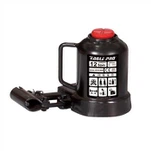
Industrial Bottle Jack, 30 ton, forged steel base.A Powerful heavy-duty jack that is ideal for use in the automotive, machinery and construction industry.
Product Characteristics
√ Used for industrial lifting and pushing applications.
√ Many jacks feature screw extensions.
√ Can be used in the vertical, angled or horizontal positions.
√ Meets ANSI/ASME PALD and CE standards.
Product Parameters
Product Name | 30 Ton Industrial Bottle Jack |
Brand | Eagle pro |
Product Type | Hydraulic Welded Bottle Jack |
Model Number | E-3230 |
Capacity | 30ton |
Min.Height | 280mm/11.02In. |
Max.Height | 445mm/17.52In |
Base Size | 202*150mm |
Net weight/Gross weight | 18.4kg/19.0kg |
Package Size | 241*164*312mm |
QTY/CTN | 1PCS |
QTY/20’CY | 920 |
Product Show


Learn How Hydraulic Jacks Work
In a hydraulic jack, fluid pressure multiplies force in a cylinder in order to lift a heavy load. They use Pascal’s law to lift the heavy load, which requires a smaller input force to lift heavy objects. They have a broad range of applications: machine shops, automobile industry, material handling equipment, lifting platforms, railway, hydropower plants, etc.
Hydraulic jacks can be automatic or manual. Unlike manual hydraulic jacks using hand power, automatic hydraulic jacks utilize air or electric power. However, the operating principle is the same.
Hydraulic jack operating principle
Hydraulic jacks are based on Pascal’s law. The law states that a pressure change at any point in an enclosed incompressible fluid transmits throughout the fluid such that the same change occurs everywhere. This law also governs the hydraulic press and the braking system for most vehicles. Pascal’s law:

Where:
△p: is the hydrostatic pressure. It is the difference in pressure between the two points.
ρ: is the fluid density.
g: is the acceleration due to gravity.
△h: is the height of the fluid above the point of measurement.


Figure 2 illustrates Pascal’s law and how hydraulic jacks work. At point A, a person applies a small amount of force to the lever. This creates a change in pressure p. The fluid at point B is in a hydraulic cylinder and transmits the pressure change evenly to point C. p at point A is therefore equal to p at point C. Since pressure is the ratio of force to the area, the larger surface area at C will distribute a proportionally larger lifting force at the same change in pressure from A. The larger force lifts the vehicle at point C. To raise the vehicle to a reasonable height, the lever at point A has to move a greater distance than the lift at point C.This motion compensates for the smaller volume in point A of the hydraulic cylinder.

Example
As an example, a 1.5-ton car is lifted with a hydraulic jack with an area ratio (C to A) of 100. The car will exert a force of approximately 15000 N at point C, but will require a force of only 150 N at point A to lift (due to the area ratio). However, for every inch the car is lifted at point C, point A will have to move a distance equivalent to 100 inches. This movement is achieved by a cycle operation involving a reservoir and a check valve (not shown in Figure 2).
Hot Tags: 30 ton industrial bottle jack, China, manufacturers, suppliers, factory, wholesale, cheap, 6 Ton Anti Leakage Bottle Jack, heavy duty air/hydraulic bottle jack, 12 Ton Welded Bottle Jack, 30 Ton Hydraulic Jack, 20 Ton Air Over Hydraulic Jack, Steel 12 Ton Air Operated Bottle Jack