How Hydraulic Jacks Work
Jacks are pieces of material handling equipment that uses force multiplication to lift or move heavy loads. The term jacks can refer to a variety of lifting devices that employ leverage and other methods of mechanical advantage to amplify an applied force to provide the ability to transport a load. Hydraulic jacks are distinguished by their use of an incompressible liquid, such as hydraulic fluid or jack oil, as the means by which force multiplication is achieved. The primary mechanism by which force is applied varies, depending on the specific type of jack, but is typically a screw thread or a hydraulic cylinder. Jacks may be categorized based on the type of mechanism used to generate the lifting force, typically mechanical power, hydraulic power, or pneumatic power.
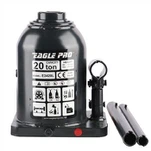
Mechanical jacks, such as the commonly used car jacks, lift heavy equipment and are rated based on the lifting capacity, which is typically expressed in terms of the number of tons that the jack can handle. Hydraulic jacks tend to have higher lifting capacities than mechanical jacks owing to the amount of force that can be generated by the hydraulic cylinders which produce the lifting action. Common forms of hydraulic jacks include bottle jacks and floor jacks.
How A Hydraulic Jack Works
Hydraulic jacks function based on a concept in fluid mechanics known as Pascal’s Principle. Essentially, if two cylinders (a large and a small one) are connected by an incompressible fluid, and a given amount of pressure is applied to one cylinder, that same pressure is imparted to the second cylinder through the fluid connecting them. However, because pressure is equal to force per unit area, the cylinder that has a larger area will experience a force multiplication effect. Even though the pressure on both cylinders is the same, the force which is produced on the larger cylinder will be higher, proportionally higher based on the area of the cylinder.
Pascal’s Principle may be expressed formulaically as follows:

Where:
F1 is the applied force to piston 1 (the pump piston)
A1 is the area of piston 1
F2 is the applied force to piston 2 (the ram piston)
A2 is the area of piston 2
By rearranging this equation to express F2 as a function of F1, A1, and A2:

This expression illustrates that the lifting force of a hydraulic jack is amplified directly by the ratio of the surface area of the two pistons.
Hydraulic jacks depend on this basic principle to lift heavy loads: they use pump plungers to move oil through two cylinders. The plunger is first drawn back, which opens the suction valve ball within and draws oil into the pump chamber. As the plunger is pushed forward, the oil moves through an external discharge check valve into the cylinder chamber, and the suction valve closes, which results in pressure building within the ram cylinder.
Product Parameters
Product Name | 30 Ton Hydraulic Welded Bottle Jack |
Brand | Eagle pro |
Product Type | Hydraulic Welded Bottle Jack |
Model Number | E3130 |
Capacity | 30 ton |
Min.Height | 275mm/10.83 inches |
Max.Height | 440mm/17.32 inches |
Screw Height | / |
Base Size | 169*153mm |
Net Weight/Gross Weight | 12.1/12.4kg |
Package Size | 215*205*310mm |
QTY/CTN | 1PCS |
QTY/20’CY | 1200 |
Our Services
1. Good knowledge on different market can meet special requirements.
2. Real manufacturer with our own factory located in Lushan Industrial Zone,Fuyang,Hangzhou 311407, China.
3. Strong professional technical team ensure to produce the top quality products.
4. Special cost control system ensure to provide the most favorable price.
5. Rich experience.
Hot Tags: 30 ton hydraulic welded bottle jack, China, manufacturers, suppliers, factory, wholesale, cheap, 3 Ton Hydraulic Car Lift Jack, Portable hydraulic bottle jack, 20 Ton Bottle Jack Low Profile, Car Mechanical Bottle Jack, 8 Ton Bottle Jack, Hydraulic Jack For Car